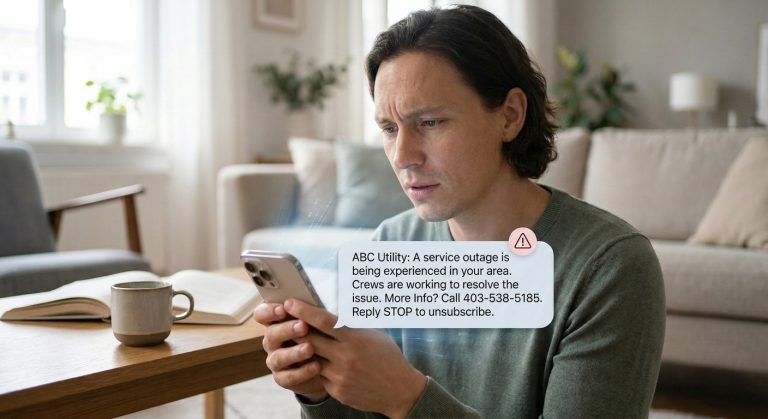
The call center gets busy during an outage. Customers want to know if the utility knows, when the problem will be fixed, and whether their bill will reflect the disruption. Most of those calls answer the same three questions. A well-designed SMS program can handle a good share of them before a customer even picks up the phone.
But most utility SMS programs don’t start there. They start with a blast list and a simple outage template, and they work fine, until the team realizes call volume hasn’t changed much, or that customers getting payment reminders are still calling in to ask about their balance. The gap between “we send texts” and “SMS is a real service channel” is where most of the operational value lives.
Why Utilities Are Rethinking Customer Communication
Phone-first communication made sense when it was the only reliable option. It’s less defensible now. Most customers read a text within a few minutes and ignore a voicemail for days. That shift in behavior applies everywhere, not just utilities, and it’s why many providers are rethinking how they reach customers at each stage of the service relationship.
The practical pressure is straightforward: call center volume for routine inquiries is expensive to maintain. Payment reminders that generate inbound calls cost more than they save. Outage notifications that don’t reach customers quickly enough produce a surge of “is the power out?” calls that staff can’t do anything about. SMS addresses each of those pressure points, but only if the program is built to handle the volume and the two-way conversation that comes with it.
The Three SMS Use Cases Every Utility Needs
Most utility SMS programs settle into three core functions once they mature: outage and service alerts, billing reminders, and payment routing.
Outage alerts are typically where programs start because the value is obvious and the urgency is high. A text that goes out within minutes of a confirmed outage, with a restoration estimate, stops a predictable wave of inbound calls. The message doesn’t need to be complicated. It needs to be fast and accurate.
Billing reminders are where programs often underperform. A reminder that says “Your bill is due” is easy to ignore. A reminder that includes the amount due and a direct link or keyword to initiate payment gives the customer something to act on immediately. That’s where SMS starts to reduce call volume instead of just informing customers.
Payment routing, connecting a text message directly to a payment channel, is the piece that completes the cycle. A customer who receives a billing reminder and can reply with a keyword to pay, call the utility’s automated phone line (IVR), or tap a link to pay online, is far less likely to call the billing department. This connection between SMS and IVR is one of the more practical integrations a utility can make, and it changes the math on how much an SMS program actually saves.
One-Way Blast vs. Two-Way Conversation
Sending outbound texts is a solved problem. The operational shift happens when customers start replying.
A customer who gets an outage alert and replies “When will it be fixed?” needs an answer. If no one is watching that inbox, two-way texting creates a worse experience than not offering it at all. This is why two-way SMS needs a plan for handling replies: automated responses for common questions, use of AI enabled communication, routing to a service queue, or all of the above.
The good news is that most inbound replies fall into a handful of predictable categories. A customer replying to an outage alert is almost always asking about restoration timing or reporting additional information. A customer replying to a billing reminder is usually asking about their balance or requesting a payment arrangement. Automated responses handle most of those without staff involvement, which is what makes two-way texting operationally practical, not just technically possible.
Compliance Basics Utility Teams Must Know
TCPA (the Telephone Consumer Protection Act) governs how utilities can send automated texts to customers. The core requirement is documented consent: customers need to have opted in before receiving automated SMS messages. For most utilities, this means building opt-in language into service agreements, online portals, or enrollment flows. The FCC has issued a TCPA exemption allowing US utilities to automatically enroll customers in SMS and automated voice communications with out prior opt-in based on a refined set of crtieria.
The STOP keyword is a federal requirement, not just a best practice. Any customer who replies STOP must be removed from the send list immediately, and that suppression has to be maintained. Platforms that don’t handle it automatically create real compliance exposure.
10DLC registration, the carrier registration system for business texting in the U.S., affects deliverability. Unregistered numbers are subject to filtering and blocking by major carriers, which is one of the more common reasons utility outage alerts fail to reach the full subscriber list. Registration ties a business’s sending number to a declared campaign type and helps carriers treat those messages as legitimate rather than potential spam.
Opt-in list maintenance also carries an ongoing burden that some programs underestimate. Customers who switch accounts, change numbers, or move off service need to be managed in the subscriber list. A broader utility notification strategy that treats SMS as one channel within a multi-channel system tends to handle this more cleanly than a standalone SMS tool, because the customer record updates in one place.
What to Look for in an SMS Platform for Utilities
The platform question matters most at the integration layer. A standalone texting tool that doesn’t connect to your billing system, customer database, or IVR means someone on your team is manually managing the trigger events, which defeats a lot of the operational value.
The features worth prioritizing: automated triggers based on billing or service events, two-way reply handling with keyword automation, STOP compliance management, delivery reporting at the message level, and a clear path to IVR integration for payment routing. That also means understanding how the platform handles list growth: whether subscriber management is manual, or whether it pulls from your existing customer records automatically.
Scalability also applies to message volume. A utility sending an outage alert to 40,000 customers in a five-minute window needs a platform built for that throughput. Consumer-grade texting tools aren’t designed for it, and the delivery delays that result during peak events are exactly when reliable delivery matters most.
Frequently Asked Questions
Can we send SMS to customers who haven’t explicitly opted in to texts?
The FCC has issued a TCPA exemption, allowing automatic opt-in for several types of communications, marketing/promotional notices require a separate opt-in. At all time the utility must support the ability to opt-out of SMS communications. Purely transactional or urgent messages, like an outage alert, can be issued as part of the automatic opt-in. Always consult your legal team or industry expert to interpret your service agreement language, but most utilities build explicit opt-in into their enrollment process to keep compliance straightforward.
Our outage texts aren’t reaching everyone — what causes delivery failures?
The most common causes are 10DLC registration gaps, sending from an unregistered number, or carrier filtering triggered by message volume spikes. Stale phone numbers in the subscriber list are also a frequent culprit. A delivery report at the individual message level, not just a batch success rate, makes it much easier to identify where the failures are occurring. Look for a partner who can support compliance efforts, and enable a verification service to keep your data accurate.
How do we link a text message to our IVR payment line without rebuilding our whole system?
In most cases, the connection is made at the platform level, not by modifying your IVR. A billing reminder can include a keyword or short URL that routes the customer into an existing IVR payment flow. The utility doesn’t need to rebuild the payment system. It just needs a clear handoff between the SMS platform and the IVR entry point.
What happens to our SMS campaign if a customer responds “STOP”?
The customer must be removed from your send list immediately and permanently until they re-opt in. A compliant platform handles this automatically and maintains the suppression list. Sending to a number that has sent STOP, even accidentally, creates TCPA exposure. This is worth confirming as a built-in platform capability before you launch.
If a customer replies to an outage alert, does someone have to manually respond, or can it be automated?
It depends on how your two-way setup is configured. Most utilities automate responses for the common reply types (restoration timing questions, confirmation requests, report-an-issue prompts) and route more complex replies to a customer service queue. A full manual response model at any reasonable volume isn’t operationally sustainable.
Conclusion
The shift from one-way outage blasts to a full SMS service channel is mostly an operations problem. The technology already exists. What matters is whether the program handles replies, connects to billing triggers, routes customers to payment, and maintains compliance as the subscriber list grows.
Most utilities that get real call center relief from SMS aren’t doing anything exotic. They’ve connected their billing events to automated reminders, built a path from text to payment, and handled the compliance requirements cleanly from the start. That’s the operational foundation. Everything else builds from it.
This is where a connected platform like Ivrnet can make a real difference. When customer records, billing triggers, outage events, and communication channels live in the same system, SMS becomes something the platform manages automatically, not something staff have to assemble by hand.
If you’re working through how to build or improve your utility SMS program, happy to walk through how other providers have approached it and where Ivrnet fits in.